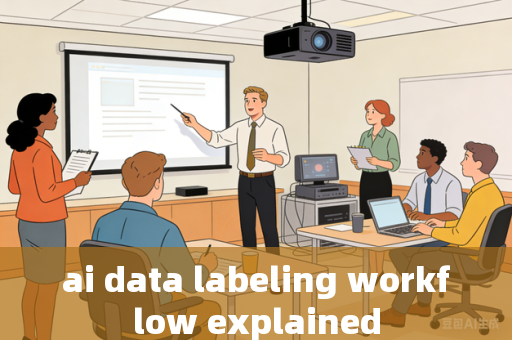
AI Data Labeling Workflow Explained
Data labeling is the process of annotating raw data (images, text, audio, video) to create training datasets for machine learning models. Here's a comprehensive breakdown of the workflow:
Core Concept
- Purpose: Transform raw data into structured, labeled datasets that teach AI models to recognize patterns
- Analogy: Like teaching a child by showing pictures and saying "this is a cat, this is a dog"
- Foundation: Garbage in → garbage out. Quality labels directly impact model performance
Key Workflow Stages
A. Project Planning & Setup
B. Annotation Process
- Task assignment: Distribute data to labelers
- Labeling methods:
- Bounding boxes: For object detection
- Polygon/semantic segmentation: For precise boundaries
- Key points: For pose estimation
- Classification tags: For categorization
- Named entity recognition: For text
- Transcription: For audio/video
C. Quality Assurance
- Multi-stage review:
- Initial labeling
- Peer review
- Expert validation
- Consistency checks: Ensure uniform application of guidelines
- Adjudication: Resolve disagreements between labelers
D. Dataset Preparation
- Splitting: Divide into train/validation/test sets
- Balancing: Address class imbalances
- Augmentation: Create variations (rotations, crops, filters)
- Format conversion: Prepare for model ingestion (COCO, Pascal VOC, TFRecord, etc.)
Common Approaches
Human-in-the-Loop
- Manual labeling: Human labelers annotate everything
- Active learning: Model suggests uncertain samples for human review
- Incremental labeling: Start small, expand as needed
Semi-Automated
- Pre-labeling: Use existing models to generate initial labels
- Human correction: Labelers refine AI-generated annotations
- Smart tools: Auto-complete, interpolation between frames
Crowdsourcing
- Platforms: Amazon Mechanical Turk, Scale AI, Labelbox
- Pros: Scalable, cost-effective
- Cons: Requires robust quality control
Quality Control Mechanisms
- Inter-annotator agreement: Measure consistency between multiple labelers
- Gold standard sets: Pre-labeled examples to test labeler accuracy
- Continuous feedback loops: Regular retraining and guideline updates
- Audit trails: Track all changes and decisions
Tools & Platforms
- Open source: CVAT, LabelImg, Label Studio
- Commercial: Scale AI, Appen, Hive Data, Supervisely
- Cloud services: AWS SageMaker Ground Truth, Google Cloud Data Labeling
Challenges & Solutions
| Challenge |
Solution |
| Subjectivity |
Clear guidelines, examples, regular calibration |
| Scalability |
Automation, smart tools, crowdsourcing |
| Cost |
Active learning, pre-labeling, synthetic data |
| Consistency |
Regular training, quality metrics, review cycles |
| Edge cases |
Expert review, continuous guideline expansion |
Real-World Examples
- Autonomous vehicles: Labeling cars, pedestrians, traffic signs in video
- Medical imaging: Annotating tumors in X-rays/MRIs
- E-commerce: Tagging product attributes (color, style, category)
- Chatbots: Labeling intent and entities in customer queries
Best Practices
- Start with pilot projects to refine guidelines
- Invest in thorough labeler training
- Implement continuous quality monitoring
- Maintain detailed version control of datasets
- Balance between speed and accuracy
- Plan for iterative improvement as models evolve
Emerging Trends
- AI-assisted labeling: Models that learn to label more efficiently
- Synthetic data generation: Creating artificial labeled data
- Federated learning: Labeling across distributed datasets
- Automated quality assessment: AI that evaluates label quality
Key Takeaway
Data labeling is not a one-time task but an iterative, quality-focused process that evolves with your AI model. The most successful implementations treat labeling as a continuous feedback loop where model performance informs labeling improvements, and better labels enhance model capabilities.
The workflow typically takes 2-8 weeks for initial dataset creation, with ongoing labeling needed as models encounter new scenarios in production.
Permalink: https://toolflowguide.com/ai-data-labeling-workflow-explained.html
Source:toolflowguide
Copyright:Unless otherwise noted, all content is original. Please include a link back when reposting.