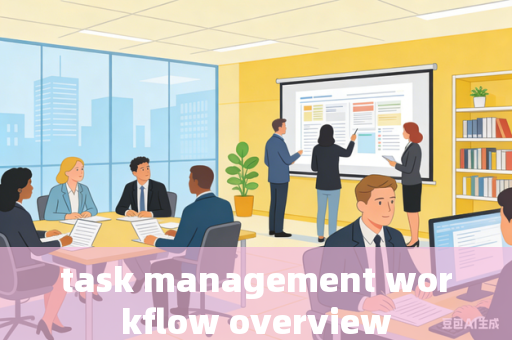
Of course. Here is a comprehensive overview of a modern, effective task management workflow, broken down into its core principles, stages, and components.
Core Philosophy
A task management workflow is not just a to-do list. It's a systematic process for capturing, organizing, prioritizing, and executing work to reduce mental clutter, increase focus, and ensure nothing falls through the cracks. The goal is to create a trusted system outside your brain so you can think about your work, not of your work.
The 5-Stage Task Management Lifecycle
This is a continuous cycle, often inspired by methodologies like Getting Things Done (GTD) and Kanban.
flowchart TD
    A[1. Capture<br>Collect Everything] --> B[2. Process & Clarify<br>What is it? Is it actionable?]
    B --> C[Actionable?]
    C -- Yes --> D[3. Organize & Prioritize<br>Categorize, Set Context, Rank]
    C -- No --> E[Trash, Reference,<br>or Incubate]
    D --> F[4. Execute<br>Choose & Do]
    F --> G[5. Review & Refine<br>Weekly & System Review]
    G --> A
Stage 1: Capture (Collect)
- Goal: Get every task, idea, project, and commitment out of your head and into a trusted collection tool (your "Inbox").
- Tools: Notebook, note-taking app (Like Apple Notes, OneNote), a dedicated inbox in a task manager (Todoist, Things), voice memos, or email.
- Rule: Capture instantly. Don't judge or organize at this stage. The act of writing it down frees mental RAM.
Stage 2: Process & Clarify
- Goal: Empty your collection points by deciding what each item means and what to do with it.
- Key Questions:
- What is it? (Define the next physical/visible action)
- Is it actionable?
- No: Trash it, file it as reference, or incubate it (add to a "Someday/Maybe" list).
- Yes: Proceed to Organize.
Stage 3: Organize & Prioritize
This is where you sort actionable items into your system.
- Organize (Categorize):
- Projects: Any task requiring more than one action step. (e.g., "Launch website").
- Contexts: Tags based on where or with what you can do the task (
@computer, @errands, @calls, @home).
- Energy/Time: Tags for how much focus or time a task requires (
@deep-work, @5-min).
- Due Dates: Only if there is a real, hard deadline.
- Prioritize (Rank):
- The Eisenhower Matrix: Categorize by Urgency and Importance (Do First, Schedule, Delegate, Eliminate).
- The Ivy Lee Method: At the end of each day, choose the 3-6 Most Important Tasks (MITs) for tomorrow.
- MoSCoW Method: Must have, Should have, Could have, Won't have (for project planning).
Stage 4: Execute (Do)
- Goal: Engage in focused work with clarity on what to do next.
- Key Practices:
- Context-Based Work: Look at your
@computer list when at your desk.
- Time Blocking: Schedule specific tasks on your calendar as appointments.
- The 2-Minute Rule: If a task takes less than 2 minutes, do it immediately during processing.
- Single-Tasking: Focus on one task at a time to enter a state of flow.
Stage 5: Review & Refine
- Goal: Keep your system functional, relevant, and trusted.
- The Weekly Review (Essential): A weekly ritual (e.g., Friday afternoon) to:
- Gather and process all loose notes/items.
- Review all projects and next actions.
- Update your task lists and calendar.
- Set MITs for the upcoming week.
- Clean up and reset your system.
- System Review: Periodically assess if your workflow and tools are still serving you.
Common Workflow Frameworks & Tools
- Kanban (Visual Workflow): Uses columns like
To Do → Doing → Done. Great for visualizing workflow and limiting work-in-progress. Tools: Trello, Asana, Notion, physical whiteboard.
- Getting Things Done (GTD): The comprehensive methodology behind the 5-stage lifecycle above. Tools: Omnifocus, Nirvana HQ, Todoist (with setups).
- Time Blocking: A calendar-centric approach where you schedule tasks as time blocks. Tools: Google/Outlook Calendar, Sunsama, Akiflow.
- Eat That Frog: Tackle your most important/dreaded task first thing in the morning.
- Pomodoro Technique: Work in focused 25-minute sprints with short breaks to maintain energy.
Choosing & Building Your Workflow
- Start Simple: Begin with Capture + a Master List. Don't over-engineer.
- Match Complexity to Need: A student's workflow will differ from a project manager's.
- Tool Selection: Choose one that feels intuitive. The best tool is the one you'll actually use.
- Simple & Fast: Todoist, Microsoft To Do
- Visual & Project-Focused: Trello, Asana, ClickUp
- All-in-One Workspace: Notion, Coda
- Calendar-Centric: Sunsama, Akiflow
- Iterate: Your workflow is a personal system. Tweak it weekly during your review until it feels frictionless.
Key Principles for Success
- Clarity Over Completion: Knowing the exact next action is more important than having a long list.
- The System is Paramount: Trust must be placed in the system, not your memory.
- Regular Review is Non-Negotiable: Without review, the system decays.
- Minimize Open Loops: An "open loop" is an unmet commitment your brain is tracking. The workflow exists to close them.
By implementing these stages and principles, you move from being reactive (constantly putting out fires) to being proactive and intentional with your time and energy.
Permalink: https://toolflowguide.com/task-management-workflow-overview.html
Source:toolflowguide
Copyright:Unless otherwise noted, all content is original. Please include a link back when reposting.